Identify the vehicle and system
Start with year, make, model, engine notes, and whether the request points to suspension, steering, wheel bearing, oil seal, or engine component work.
Give buyers a focused route from vehicle need to Suspension & Steering Parts and Engine Components, with application context and sourcing support close at hand.
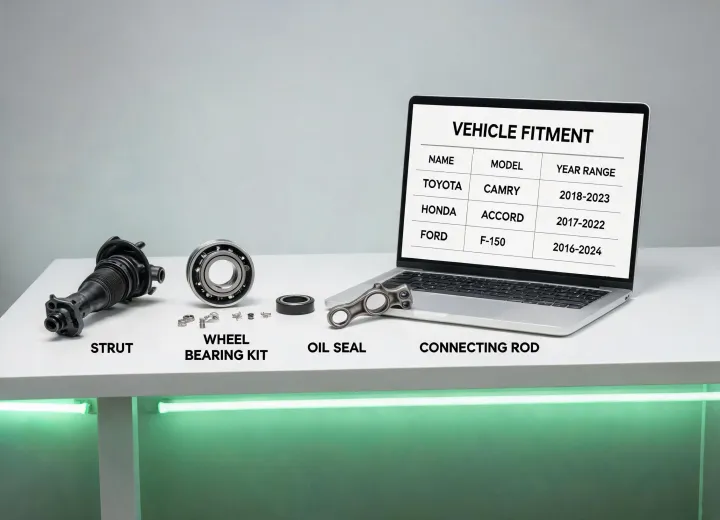
Many automotive parts requests fail because the first message is too thin. A buyer may send a partial part number, a technician may describe a noise instead of a system, or a catalog user may search for a wheel bearing without confirming the vehicle details. SKF's fitment guide is arranged to slow that confusion just enough to gather the useful facts. The process still feels quick, but it gives support teams the context needed to answer without sending the customer through repeated clarifying emails.
Start with year, make, model, engine notes, and whether the request points to suspension, steering, wheel bearing, oil seal, or engine component work.
Add the removed part number, a catalog code, measurement notes, or a photograph of the old unit when those details are available.
Tell SKF whether the outcome is a quote, stock planning, return review, catalog wording, or a fast workshop confirmation.
For struts, hub assemblies, control arms, tie rods, and related components, the most useful request explains the service symptom and the mounting context. A workshop might know that a hub assembly is noisy but still need help confirming the correct side, generation, or kit path. A distributor may need the same information to avoid stocking a part that appears close in search results but does not match the service reality.
SKF guidance treats these questions as application conversations, not just catalog lookups. That gives the buyer a better chance to connect the part family with the vehicle, the quantity, and the urgency behind the order.
For engine components, oil seals, and related cross-reference questions, the request should include measurements or source numbers whenever possible. A seal inquiry by size needs a different response than a connecting rod or bearing discussion. SKF support can use those differences to prepare an answer that fits the customer's workflow instead of flattening every request into a generic engine parts message.
The same discipline helps catalog teams. When pages mention oil seal size charts, piston seals, or wheel bearing comparisons, the support route should capture enough context to keep buyers from mixing incompatible references.
Gather the vehicle, part family, and source number details, then send the request through SKF's inquiry path.